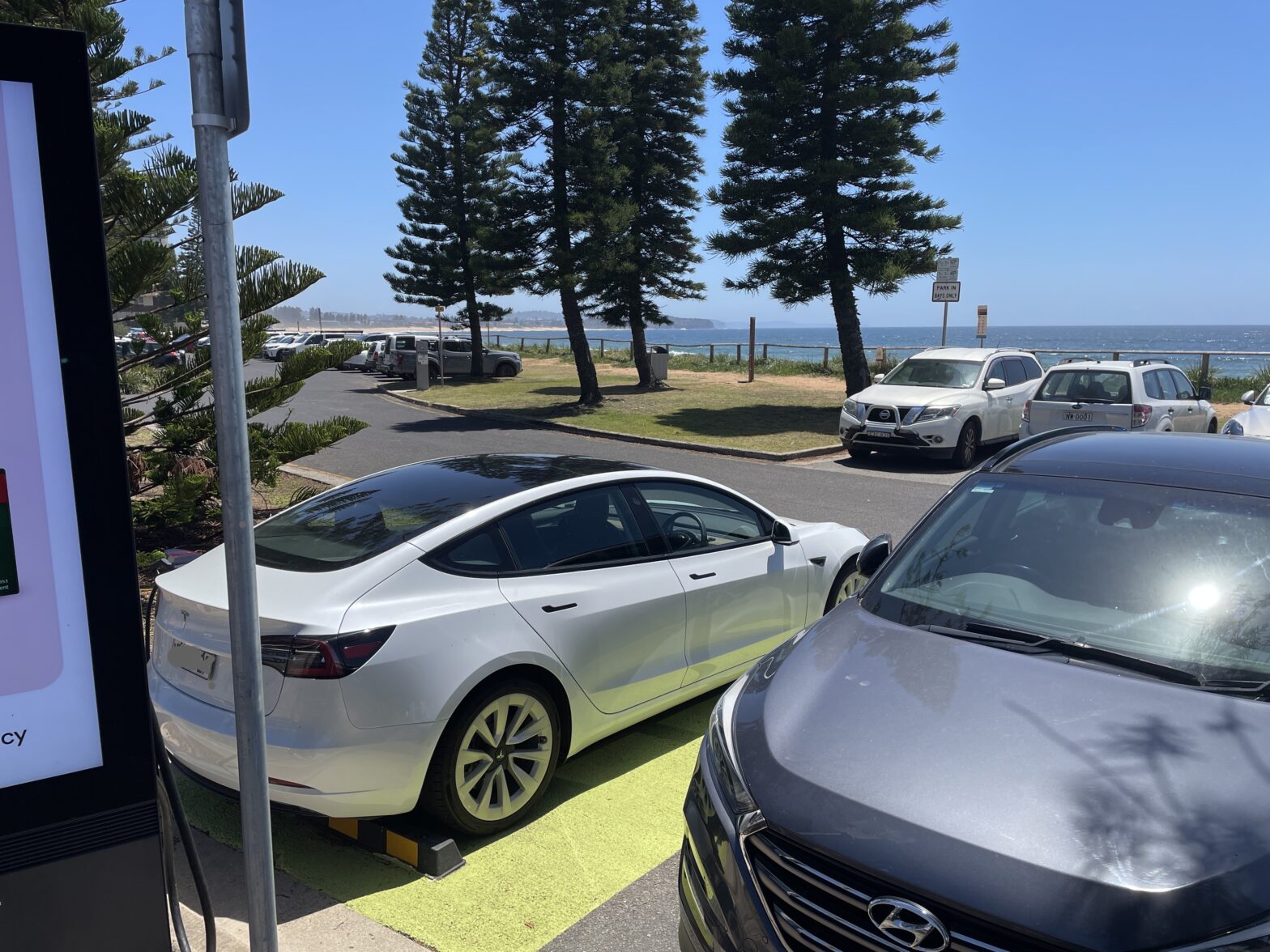
Australia is a large continent, so there are different EV charging costs for each person, depending on where they drive and where they charge.
For example, charging at Tesla Superchargers, is currently a median price of 52c/kWh
That rate of 52c/kWh is equivalent to $7.80 per 100km. This is based upon an EV which uses 15kWh each 100km, such as a Tesla Model 3 Long Range Dual Motor AWD.
Below are observed DC EV Charging Prices in Australia, updated 23 December 2025
Sample DC Charging Prices
^^As at 23 December 2025 Of the 148 Tesla Supercharger sites, 98 are flat rate, 50 are ToU. Currently the Tesla median flat rate is 52c/kWh. Tesla prices shown are for Tesla vehicles. A Supercharger Membership ($9.99mth), allows other vehicles same price as Tesla vehicles at those Superchargers which are open to non Teslas. *Wevolt at Moama Bowling Club is free. **From 8-1-26 Jolt Daily plan has $1.99 service fee which includes first 7kWh then fixed rate depending on speed and location. Jolt Pro plan has no service fee and different pricing, including ToU. ***Chargefox at Cobblebank Vic, Urbnsrf Tullamarine Vic, Waddamana Tas are free. ****Evie give 4cKWh discount to RACQ members at Chargers in Qld. ++ Chargefox gives members of motoring organisations a discount at 21 selected DC locations. RAA SA Members get 10% at all RAA locations. +++NRMA app has lower pricing than using Chargefox RFID or app at NRMA chargers and members get a further 5c/kWh discount if they use NRMA App.
* The $/kWh price is the most common method used by DC EV charging networks, but some use a range of other methods, in addition to or instead of a kW/hr rate. DC Pricing may include an hourly fee while charging, or when congested, like 50c/minute, or an Idle Fee if you remain parked after charging. Some DC Idle fees are from 3c to $2/minute, so always good to move the car when finished charging.
Table: Sample Type 2 AC Charging Costs*
Sample of AC EV Charging Costs
* The $/kWh price is the most common method used by AC EV charging networks, but some use a range of other methods, in addition to or instead of a kW/hr rate. Pricing may include a Session Fee and or an hourly Duration Fee while charging, or an Idle Fee if you remain parked after charging. Some Session Fees are $5, some AC duration fees are 20c/minute and some AC idle fees are up to $1/minute. So always check pricing in the app and move the car when finished charging.
Prices may have varied since they were last checked.
There are over 30 EV charging networks across the continent of Australia. 3 of the large networks offer autocharge, starting automatically when you plug in. Half let you add and use your own single RFID card or tag, to activate them. Some have credit card terminals, some use QR codes to a portal, most have an app, some a combination of methods.
The most common method used for the price of EV charging is $/kWh, but networks may use a mix of pricing methods, including a Parking Fee, Duration Fee, Idle Fee, Minimum Price, Connection Fee, Flat Fee or Reservation Fee.
Energy Fee
The Energy Fee is used by most EV Chargers and is a cost of $ per kWh used by the EV. This price might be called by different names, such as Charging Rate $k/Wh, Fee per kWh $k/Wh, Energy Delivered Rate $/kWh, Tariffs $/kWh, Price $/kWh, Session Fee $/kWh, Units $/kWh, Charge Fee $/kWh, Energy Fee $/kWh. The rate may be fixed or change with time of day.
Parking/Duration Fee
An EV charging network may use a time based Duration Fee in addition to, or instead of, a $/kWh price. Some networks call these a Duration Fee, Parking Fee, Cost Per Minute or Congestion Fee and are priced as $/min while your EV is connected to the charger. Duration fees may start immediately on commencing charging, or may start after a period of time, or after your EV reaches a set % of charge. Some duration fees, like a Congestion Fee, might only be charged if the chargers are busy. The App should describe when it applies.
Idle Fee
An idle fee is a Duration Fee that continues or starts after you finish charging but your EV remains parked in the EV charging bay after charging. Some networks call idle fees an Idle Fee, Overstay Fee, Occupancy Fee, Overtime Penalty or Congestion Fee.
Minimum Price
Some networks list a Minimum Price, Minimum Cost or Minimum Spend to be charged, to cover their costs.
Connection Fee
Some networks add an additional Connection Fee, usually a set charge, once you connect your EV. Some networks call these a Session Fee, Starting Tarrif, Flat Fee or Service Fee.
Grace Period
Some networks will display a period of time before a Duration Fee or an Idle Fee will commence.
Reservation Fee
Some networks may charge a fee for you to reserve an EV charging bay until you arrive.